


How we automated the full care cycle for the Netherlands' busiest walk-in STI clinic.

We built the complete EHR and operational backbone behind ZIZ: a provider portal that automates everything from patient intake and lab diagnostics to prescriptions, GP updates, and follow-ups. What used to take dozens of manual steps now runs smoothly in one system.

Client ZIZ
Industry Biomedical / Life Sciences
Timeline 2021 - Ongoing
YNA TEAM ~ 8 people

Stats

  • +3 million Euro raised
  • < 60s Patient registration
  • Real time Lab results ingestion
  • +70.000 Visitors
  • 8 workflows Fully automated
  • 12 3rd part integrations

About

ZIZ is one of the largest walk-in sexual health clinics in the Netherlands, handling high patient volumes daily. Before our engagement, nearly every operational step was manual: intake processing, patient ID, registration, insurance and GP verification, phone-based follow-ups, lab result retrieving, prescriptions and medication management.
 

Project scope
  • End-to-end provider portal covering the full patient care cycle.
  • Automated patient identity, registration and insurance screening at order placement against national databases.
  • Package integrations and logistics for test kits and medication.
  • Real-time lab integration with automated diagnosis support.
  • Automated prescription and medication workflows.
  • Smart GP and patient notification routing.
  • Patient and provider full audit trails.
  • Analytics cockpit for operational intelligence.

The challenge

Running a walk-in clinic means there's no scheduling buffer. Patients arrive continuously, and every minute spent on administration is a minute not spent on care. ZIZ needed to eliminate manual handoffs across the care cycle without changing the walk-in model that makes the clinic accessible.
 

What needed to be automated
  • Patient identity verification and insurance lookup.
  • Lab test ordering and result retrieval.
  • Diagnosis workflows.
  • Prescription generation.
  • GP notifications.
  • Patient notifications and reminders.

Identity at the front door

When a patient places an order through ziz.nl, the system doesn't take their word for it. Every submission is matched in real time against national registers. A misspelled name, an outdated address are all flagged on the spot, with a side-by-side comparison for the provider.

  • No manual lookups.
  • No phone calls to confirm identity.
  • No orders processed under the wrong person.

A wrong identity means wrong lab results, wrong prescriptions, failed declarations. We catch it at the door.

One board runs the clinic

The clinic's entire operation runs from one board. Every paid order becomes a card that moves through the care cycle carrying its operational context with it.

That overview used to be scattered across tens of tools and in people's heads. Now there's one source of truth, and every role reads from it: front desk, clinician, nurse, doctor, lab. Nobody asks where a patient is. The board already says.

Advice is generated. Decisions are checked.

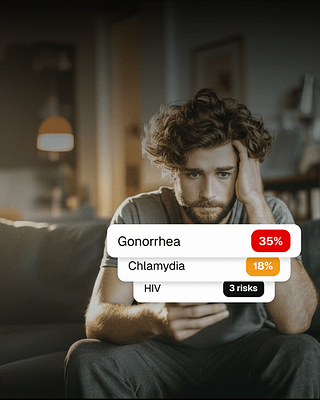
Per-STI likelihood models guide patients to the right tests and give clinicians a head start on every order. Each model is trained on how patients with comparable intake answers actually tested, so the advice reflects real outcomes. The check that used to take a full manual review now starts from a prepared answer.

  • Models scoring 0.87 AUC guide the advice.
  • A clinician reviews every order way faster.
  • Deviations from the advice surface immediately.
  • Flags resolve before the patient is in the room.

The physical process drives the digital one.

A clinic runs on physical things: samples, rooms, shipments, lab equipment. The portal is wired into that reality, not parked next to it. Orders advance as the real-world process happens: samples tracked from collection to analysis, lab results ingesting in real time, testing kit shipments feeding delivery milestones straight into the order.

  • Real-time lab results ingestion.
  • Status follows the physical process, automatically.
  • Shipment tracking inside the order, not in a carrier portal.

Case management: the clinical cockpit

Results arrive, and the portal walks the care team through the clinical sequence in one screen: allocate the patient, run the safety assessment, diagnose, prescribe, inform the GP.

For a walk-in clinic, that screen is where speed materializes. A patient can walk in, test, and leave treated all in the same visit. Fewer handoffs also means fewer places for a case to stall or a detail to slip: the context is assembled by the system, not reconstructed by whoever picks up the case next.

  • Results shown against the patient's full history.
  • Safety questions answered before prescribing, not after.
  • GP informed automatically, verified via ION.

Four eyes on every prescription

Clinicians propose treatment. A doctor signs it off. The portal makes that safeguard scale by doing the triage itself: standard cases in one queue, everything that deviates from the guidelines or carries a risk flag routed straight to the doctor. The doctor's time goes where the risk is.

  • Off-guideline prescriptions can't skip the doctor.
  • Risk flags travel from assessment to approval.
  • Routine cases approved in bulk.

The loop closes with the patient.

Automatic evaluations are send after an order finishes. The portal turns the answers into an insights cockpit: satisfaction scores and narrative feedback, tagged by theme and location. The clinic reads what patients actually experienced. The next improvement starts with evidence, not anecdote.

  • Every finished order feeds the evaluation loop.
  • Quantitative scores and free-text feedback in one view.

What this project shows.

We built a hybrid system: rule-based questionnaire logic combined with calibrated ML models, served through a production REST API.

Workflow beats features.

We modeled how care actually moves and let physical events, like a scanned vial, drive the digital state.

Automation with a human in the loop.

ML advice, national-register checks and automatic doctor-routing prepare decisions. People make them, and the system records that they did.

One system, every role.

Front desk, clinicians, nurses, dermatologists, doctors and lab staff work in the same portal, each seeing their own action items against the same shared truth.

{quote}

Do you work in healthcare and thinking about automation?

Tell us where your team is losing time. We'll tell you what's worth automating and what isn't.

Voorstel aanvragen