


How machine learning helped 70,000+ people choose the STI tests they actually need.

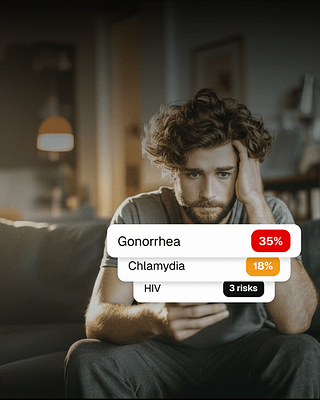
Every patient starts online. You fill out a questionnaire and immediately see which STIs you might have, and how likely each one is. That prediction comes from a machine learning model trained on tens of thousands of people who came before you. So you know which tests actually make sense for you. We built the machine learning behind it.

Client ZIZ
Industry Healthcare
Timeline 2021 - Ongoing
YNA TEAM ~ 8 people

Stats

  • +3 million Euro raised
  • +70.000 Training records
  • 3x to 12x Risk differentiation
  • +148 Questionnaire fields
  • AUC 0.87 Risk prediction

About

ZIZ is the busiest walk-in STI clinic in the Netherlands. Every visit starts the same way: the patient fills in a questionnaire. That form is the first clinical moment of the visit, and it's where the clinic works out who needs which test, and who needs to be seen soonest.

The problem was timing. A risk assessment is only useful if it comes back straight away, not hours later when someone finally reviews the answers. It has to be right, it has to work every single time, and it has to stand up to an audit.


The challenge

Turning questionnaire answers into a useful risk score is harder than it sounds. The model has to handle five conditions at once, work out a real probability for each one, sort them into risk levels, and explain all of it in language a patient can actually understand. All while they're standing there filling in the form on their phone.

And this is healthcare, so it has to hold up. Patient data has to be handled properly. Every prediction has to be logged. You need to be able to show exactly what the model was trained on. Plenty of models work in a demo. This one had to survive an audit.


Requirements
  • Predict how likely each STI is, based on what the patient fills in. 
  • Display clear risk levels the patient can actually understand. 
  • Deliver predictions in real time via an API integration. 
  • Train on real patient data, fully traceable. 
  • Monitoring and an audit trail on every prediction.

What we built

Two things working together: the questionnaire that asks the right questions, and the models that turn those answers into a risk score. Both running live behind an API.

The questionnaire

It's not a flat form. The questions change depending on what the patient answers, so someone at low risk gets a short form, while someone who needs more context gets asked more. Nobody has to slog through 148 questions that don't apply to them. And the moment you finish, your prediction is right there.

Written for patients

The model gives you a probability, but a bare number doesn't tell a patient much. Is 35% high or low? Should you be worried or not? So we didn't just show the number, we showed what it means: where the probability comes from, how it turned out for other people who answered the same way, and what your best next step is. That way you don't just know your risk, you know what to do about it.

And the number has to be right. Most models hand back something that looks like a probability but isn't. A model like that says "70%" for a hundred people, and only forty of them test positive. We calibrated ours against real outcomes, so 70% actually means 70%. Each STI gets its own model, with its own signals and its own risk levels.

Built to survive an audit

Patient data handled properly. Every prediction logged. Every version of the model saved, so we always know exactly what it was trained on and can rebuild it from scratch. The system monitors itself and retrains as the data shifts.

The result

You used to have to guess which tests you needed. Now you see your odds for each STI first, and choose from there. And before anything gets tested, a clinician checks that your choice makes sense.

A boring intake form turned into the most important moment of the visit.

{quote}

Bas

Director at ZIZ

Do you work in healthcare and are you thinking about AI?

Tell us what you're up against. We'll tell you what's possible and what it costs.

Request proposal